

What is Search Engine Optimization?
Search Engine Optimization is the process of improving a website so it can appear prominently in search engine results when people search for relevant information, products or services. SEO helps search engines understand your website while making your content easier and more useful for visitors.
SEO includes important activities such as keyword research, on-page SEO, technical SEO, content optimization, internal linking and off-page SEO. These practices help improve website visibility and attract organic traffic without depending entirely on paid advertising.
For businesses SEO can increase visibility, website traffic, brand awareness, user engagement and potential conversions. A successful SEO strategy focuses not on search rankings but also, on providing valuable, relevant and trustworthy content to users.
In words SEO helps your website become easier for search engines to understand and easier for people to find.
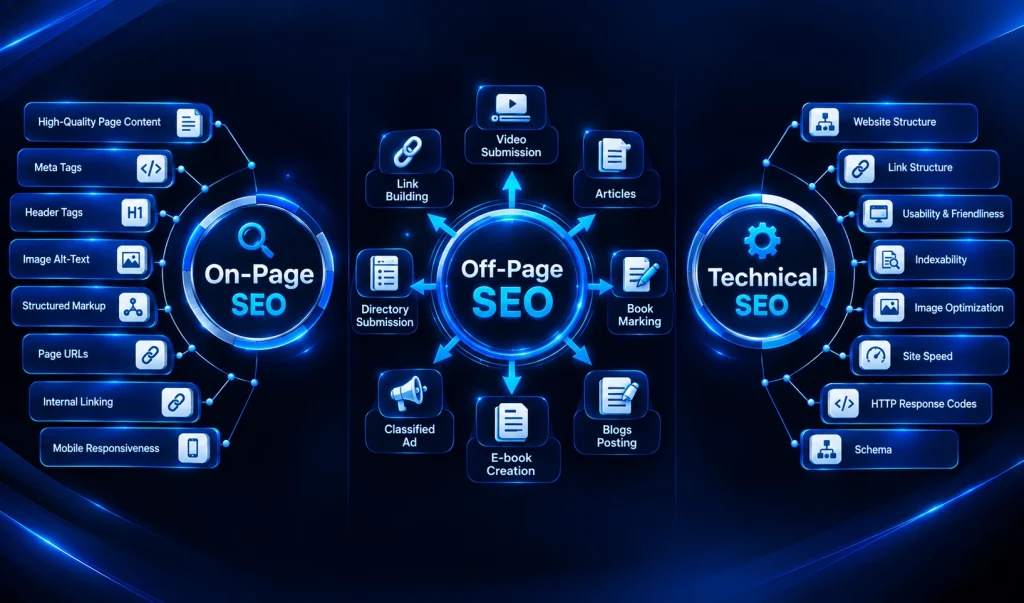
Diffrent Sides Of SEO That Grow Your Buisness
Our SEO Working Process
At **SHREE-INFO** we follow an organized SEO process. Our goal is to boost your website’s visibility bring in the kind of traffic and help your online presence grow steadily over time.
Website Audit
We thoroughly analyze your website to identify SEO, technical, and performance issues. We evaluate site structure, page speed, keywords, backlinks, and overall search performance. Our audit provides clear insights to strengthen your website and improve its SEO potential.
Keyword Research
We identify relevant keywords that match your audience’s search intent and business goals. We analyze search trends, competition, and keyword opportunities to target the right terms. Our research helps your website attract qualified traffic and improve its search visibility.
Optimization
We optimize your website’s content, pages, and technical elements for better search visibility. We improve headings, meta tags, URLs, content structure, and on-page SEO factors. Our optimization process helps search engines understand your website and supports higher rankings.
Growth Tracking
We continuously monitor your SEO performance to measure progress and identify new opportunities. We track rankings, organic traffic, clicks, impressions, and other key performance metrics. Our regular analysis helps refine your strategy and maintain steady, long-term growth.
Techniques of SEO

Black Hat SEO

White Hat SEO

Grey Hat SEO
Black Hat SEO
Black Hat SEO is a way of trying to get a website in search engine results by using tricks instead of giving real value to people. These tricks might work fast. They can cause big problems for a website’s future. They can hurt how visible the site is, damage its reputation and reduce the number of people who visit it through search engines.
Some of the Black Hat SEO tricks are putting too many keywords on a page hiding text so people can’t see it showing different content to search engines and visitors making lots of fake links and using bad link strategies. Also creating pages that copy pages putting spam comments and making links that take people to the wrong place are all part of this. Keyword stuffing means using the words over and over in a way that doesn’t make sense. Cloaking means showing one thing to search engines and something else to people.
Another trick is making pages that’re not good quality or made by a computer just to get search traffic. These pages don’t help people. Don’t answer what people are looking for. Search engines are always getting better at finding these tricks and looking at things like how good the content’s how relevant it is, how useful it is, how well the website works and how good the experience is for users.
Using Black Hat SEO can mean losing rankings being taken out of search results or getting a warning from the search engine. Even if a site gets rankings for a while those rankings might not last.
To do well with SEO for a time companies should use honest and helpful methods. This means making useful content doing good keyword research making the website easy to use and fast getting real links from good websites making the experience better for people and checking how the SEO is doing all the time. A good SEO plan is, about building trust and offering value not trying to trick the search engines.
Black Hat SEO can also harm a website in ways beyond search rankings. When a website uses tricks visitors might see things like useless content, too many keywords, fake links or pages that don’t help them. This can make people not trust the website and they might leave quickly. In the run bad experiences can make it harder for a business to grow online.
Another big problem is that Black Hat SEO doesn’t last. Search engines keep changing their rules to make sure results are better and more relevant. A trick that works for a while might stop working after an update. Websites that use these tricks a lot might suddenly lose their search visibility and traffic.
White Hat SEO
White Hat SEO means using methods to improve a website’s visibility and rankings. It follows the rules set by search engines. This is very different from Black Hat SEO, which uses tricks and deceptive tactics to get results. White Hat SEO is about helping search engines understand a website clearly and giving value to visitors. The goal is to offer information that’s relevant and trustworthy. It may take time and effort. White Hat SEO creates results.
One important part of White Hat SEO is making high-quality content. The content should answer questions provide details and match what users are searching for. Businesses can create blogs, service pages, how-to guides, FAQs and case studies that meet the needs of their audience. Keyword research is also very important. It shows what people are actually searching for. Keywords should be used naturally in the text. They should not feel forced or out of place.
On-page optimization is another area. This means making sure titles, headings, meta descriptions, URLs, internal links and image alt text are all set up correctly. These elements help search engines understand what each page is about. They also make the website easier for users to navigate. Technical SEO is just as important. A good website has a structure loads fast works well on devices uses secure connections and gives visitors a smooth experience.
Earning quality backlinks the right way is also crucial. Of buying links or joining link schemes businesses should share helpful resources do original research and offer useful insights. Building relationships with websites can lead to others linking to their content naturally. Internal linking also helps users find topics. It also helps search engines see how different pages are connected.
White Hat SEO also needs checking and updating. SEO experts can monitor traffic, keyword rankings, conversions, technical issues and how users behave on the site. This data helps them see what is working and what needs to be improved. Based on the results they can update content and technical parts to keep the site relevant and helpful.
In the end White Hat SEO is, about making a website that earns its visibility through work and quality. By combining content, keyword use, technical improvements, a great user experience, natural backlinks and ongoing updates businesses can build a strong foundation. This leads to lasting search visibility and steady organic growth.

Grey Hat SEO means using search engine optimization methods that sit between White Hat SEO and Black Hat SEO. It is a ground where techniques are not always outright banned by search engine rules but they may try to lift a site’s ranking without fully honoring the true spirit of ethical SEO. Grey Hat SEO is popular with site owners and marketers who want results than traditional SEO can give but these techniques carry risk because search engine rules and algorithms can shift over time.
One common example of Grey Hat SEO is link building. Of earning every backlink naturally a site may use tactics like posting on other blogs only for links joining certain link‑building networks or creating content mainly to attract links rather than to give real value. The quality and relevance of these links can differ a lot. While some guest posting and outreach are excessive or manipulative link‑building can become dangerous.
Another Grey Hat SEO method can involve content manipulation or large‑scale content creation. For instance a site may make pages that target closely related keywords with only small differences between them. Some businesses also update content mainly to target extra keywords or search queries. Updating content is normal in SEO. Changing it only to manipulate rankings without improving usefulness can be problematic.
Grey Hat SEO may also include tactics such as using expired domains, private blog networks many exact‑match anchor texts and building multiple sites to boost search visibility. Whether a tactic is counted as Grey Hat depends on how it’s used, its purpose and whether it breaks specific search engine rules. Therefore not every tactic called “Grey Hat” is automatically harmful or forbidden.
The main worry with Grey Hat SEO is uncertainty and risk. A tactic that works now might lose power after a search algorithm update. If search engines find that a site uses practices its visibility can suffer. This can lead to organic traffic and extra effort to restore the site’s search performance.
For businesses that care about long‑term growth it is safer to focus on high‑quality content, relevant keyword research, solid technical SEO, useful internal linking, fast site performance, an user experience and naturally earned backlinks. Learning about Grey Hat SEO is helpful because it lets marketers see the line between optimization and increasingly manipulative tricks.
Ultimately Grey Hat SEO sits in a zone, between clear ethical and clear manipulative SEO practices. Because the lines can shift and depend on how a tactic’s applied marketers should examine each strategy carefully and decide if it truly benefits users instead of just chasing higher rankings.

Frequently Asked Question
SEO helps businesses increase organic visibility, attract relevant visitors, build online credibility, and generate potential leads without relying entirely on paid advertising.
Digital marketing helps your business reach the right audience, increase online visibility, generate quality leads, build brand awareness, and achieve sustainable growth.
SEO usually requires consistent effort and time. The timeline can vary depending on website condition, competition, industry, content quality, and the SEO strategy being implemented.
Keyword research is the process of identifying words and phrases that people use when searching for products, services, or information online. These keywords help guide content and website optimization.
On-Page SEO focuses on optimizing elements within a website, including headings, content, page titles, meta descriptions, URLs, images, internal links, and keyword placement.
Off-Page SEO refers to activities performed outside the website to strengthen its online presence and authority. This can include earning relevant backlinks, digital PR, outreach, and brand mentions.